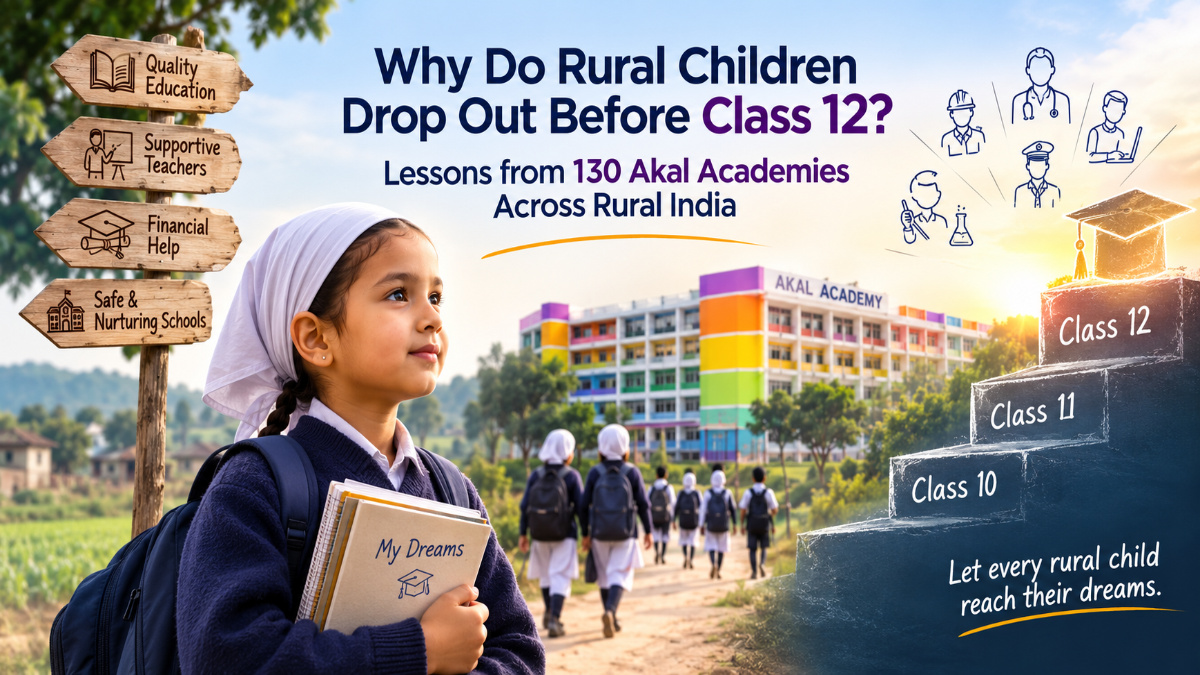
Why Do Rural Children Drop Out Before Class 12? Lessons from 130 Akal Academies Across Rural India
By EducateToSave | The Kalgidhar Trust (The Kalgidhar Society), Baru Sahib
Quick Answer
While India has made remarkable progress in expanding access to primary education, millions of rural children still leave school before completing Class 12. Financial hardship, learning gaps, limited access to quality teachers, family responsibilities, and a lack of continued academic support remain among the biggest reasons. Through its network of 130 Akal Academy schools, The Kalgidhar Trust has developed a rural education model that addresses these challenges through quality teaching, low student-teacher ratios, value-based education, and financial assistance for deserving children.
India's Education Story: Progress with an Important Challenge
India has transformed access to education over the past two decades.
According to NITI Aayog's National Multidimensional Poverty Index, school infrastructure has improved significantly. Primary school enrolment is now around 90.9%, and most schools have access to electricity, drinking water, and separate toilets for girls and boys.
These are important achievements.
Yet another reality emerges as children move through the education system.
-
Secondary enrolment: 78.7%
-
Higher secondary enrolment: 58.4%
-
Secondary dropout rate: 11.5%
In simple terms, this means that millions of children who begin their educational journey never reach higher secondary education, limiting their future opportunities for higher education, skilled employment, and economic mobility.
The numbers tell a concerning story.
Many children who begin school never reach Class 12.
The question is not whether children want to learn.
The question is why so many are unable to continue.
Prefer visuals? Read our infographic report summarising these statistics and the Akal Academy rural education model.
Why Do Rural Children Drop Out Before Class 12?
For many rural families, education is never taken for granted.
Parents understand its value.
Children have aspirations.
But circumstances often become stronger than ambition.
Some of the most common reasons include:
-
Financial hardship
-
Declining agricultural incomes
-
Migration for seasonal work
-
Lack of academic support after primary school
-
Limited access to experienced teachers
-
Pressure to contribute to family income
-
Transportation challenges
-
Early marriage for girls in some communities
-
Low confidence due to learning gaps
-
Absence of role models pursuing higher education
The transition from middle school to secondary education is where many students begin to disappear from the system.
Not because they lack ability.
Because they lose support.
These challenges have also been discussed in an analysis published by Youth Ki Awaaz, "Punjab Fed India. Why Are Its Rural Children Falling Behind?", which examines how weakening rural incomes are affecting children's educational opportunities.
Infrastructure Alone Cannot Solve the Problem
India has rightly invested in school buildings, sanitation, and infrastructure.
These investments matter.
But classrooms alone cannot keep children in school.
A child rarely leaves education because the building is inadequate.
More often, they leave because they begin believing education is no longer possible.
Perhaps the curriculum becomes difficult.
Perhaps no one is available to guide them.
Perhaps financial pressures become overwhelming.
Keeping children in school requires more than infrastructure.
It requires relationships.
Teachers.
Mentors.
Financial support.
Belief.
A Different Rural Education Model
Since 1986, The Kalgidhar Trust (The Kalgidhar Society), Baru Sahib has worked to address these challenges through a different educational approach.
Today, 130 Akal Academy schools serve rural communities across Punjab, Haryana, Himachal Pradesh, Rajasthan, and Uttar Pradesh.
The goal has never been merely to build schools. It has always been to ensure that children enter, stay, thrive, and graduate.
Several features distinguish the Akal Academy model.
70% First-Generation Learners
Approximately 70% of students studying in Akal Academies are first-generation school-goers.
Many come from farming families, daily-wage labourers, and economically disadvantaged households where parents may never have had the opportunity to complete formal education themselves.
For these children, school is more than a classroom.
It is the first step toward changing the trajectory of an entire family.
Smaller Student-Teacher Ratio
Teacher availability plays a critical role in student success.
Across Akal Academies, the student-teacher ratio is approximately 20:1, significantly lower than the 30:1 ratio prescribed by CBSE.
Smaller classrooms allow teachers to:
-
Provide individual attention
-
Identify learning gaps early
-
Build student confidence
-
Mentor children beyond academics
-
Strengthen relationships with families
When students feel supported, they are more likely to remain engaged throughout secondary school.
Education Regardless of Financial Circumstances
Perhaps the most significant feature of the model is its commitment to accessibility.
Nearly 30% of students study through scholarships, sponsorships, or subsidised education, ensuring that financial hardship does not force deserving children to discontinue their studies.
Through the EducateToSave initiative, compassionate donors, NRIs, philanthropists, and CSR partners help remove financial barriers for children who would otherwise struggle to continue their education.
The Results Speak for Themselves
The effectiveness of a rural education model is measured not only by enrolment but by outcomes.
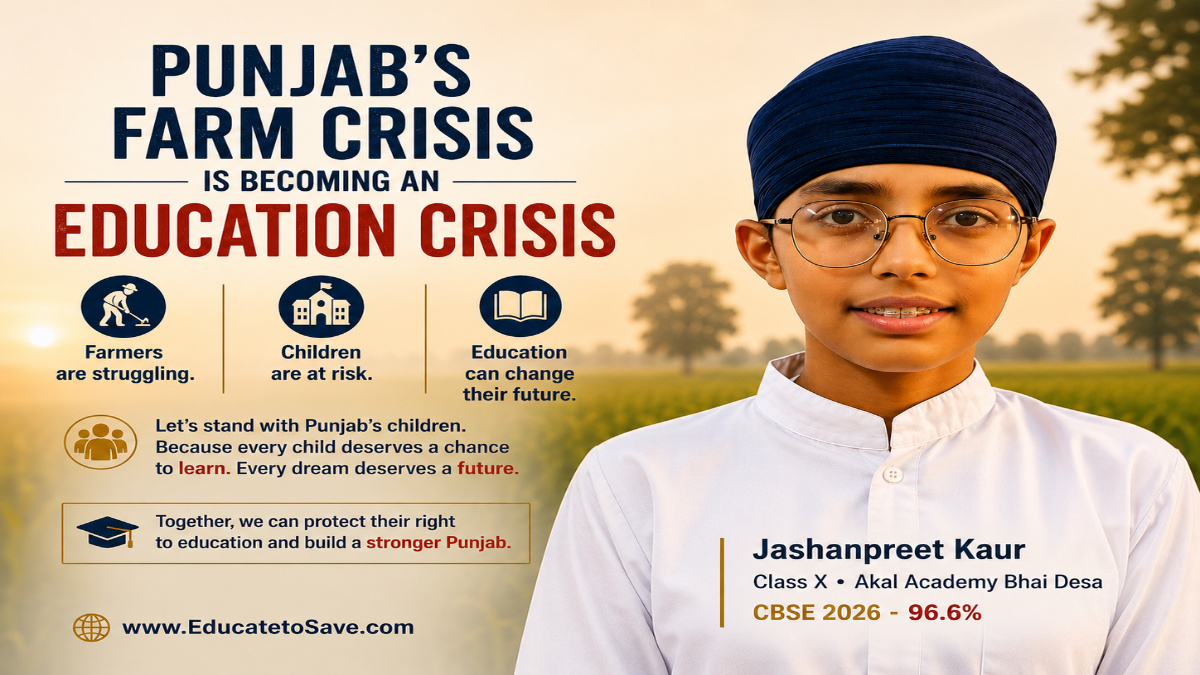
The CBSE Class X Results (2025–26) across Akal Academies reflect what becomes possible when children receive consistent academic and emotional support.
-
4,287 students appeared
-
130 rural schools
-
100% pass percentage
Academic excellence included:
-
37 students scored above 97%
-
635 students scored above 90%
-
1,852 students scored above 80%
These achievements did not emerge from expensive coaching centres or urban advantages.
They emerged from rural classrooms where committed teachers, supportive learning environments, and consistent mentoring helped students realise their potential.
Rural Talent Has Never Been the Problem
Children studying in villages possess the same curiosity, creativity, and intelligence as children anywhere else.
The difference is opportunity.
When rural students receive:
-
Quality teachers
-
Individual attention
-
Financial support
-
Value-based education
-
Exposure to technology
-
Encouragement to dream
they consistently demonstrate that excellence is not limited by geography.
Across Akal Academies, students have gone on to become:
-
Doctors
-
Engineers
-
Chartered Accountants
-
Scientists
-
Researchers
-
Entrepreneurs
-
Civil servants
-
International competition finalists
-
CBSE toppers
Their success reflects the power of sustained educational support.
Why Continuity Matters More Than Enrollment
Getting a child into Class 1 is only the beginning.
The real challenge is ensuring they confidently walk into Class 12.
Continuity requires:
-
Motivated teachers
-
Academic mentoring
-
Emotional support
-
Affordable education
-
Parent engagement
-
Strong values
-
Safe learning environments
When these elements come together, children remain in school.
And when children remain in school, communities begin to transform.
How EducateToSave Helps Rural Children Stay in School
Education should never end because a family cannot afford it.
EducateToSave, the child sponsorship initiative of The Kalgidhar Trust, connects donors with deserving rural students studying in Akal Academy schools.
Through educational sponsorship, children receive access to:
-
Quality CBSE education
-
Experienced teachers
-
Learning resources
-
Safe campuses
-
Character and values-based education
-
STEM and Future Skills programmes
-
Opportunities for higher education
Today, more than 33,000 students receive free or subsidised education across the Akal Academy network through scholarships and donor support.
Thousands more continue to await sponsorship.
For approximately ₹88 per day, a donor can help ensure that another child remains in school.
A Shared Responsibility
Keeping rural children in school is not solely the responsibility of governments.
It requires participation from families, educators, civil society, philanthropists, corporations, and communities.
Individuals can sponsor children through EducateToSave.
Companies can strengthen rural education through CSRforChange, supporting teacher development, digital classrooms, STEM education, school infrastructure, AI & Robotics Labs, and scholarships for economically disadvantaged students.
Together, these efforts create lasting educational transformation.
Frequently Asked Questions
Why do children drop out of school in rural India?
The most common reasons include financial hardship, declining family income, lack of access to quality teachers, migration, household responsibilities, transportation challenges, and limited academic support during secondary education.
How does The Kalgidhar Trust help reduce school dropouts?
The Kalgidhar Trust operates 130 Akal Academy schools that combine quality education, low student-teacher ratios, value-based learning, and financial assistance through EducateToSave to help children remain in school.
What is EducateToSave?
EducateToSave is the child sponsorship initiative of The Kalgidhar Trust that helps deserving children from economically disadvantaged rural families access quality education regardless of their financial circumstances.
How many students receive financial assistance?
Today, more than 33,000 students receive free or subsidised education through donor support and scholarship programmes across the Akal Academy network.
Why is a lower student-teacher ratio important?
A smaller student-teacher ratio allows teachers to provide personalised attention, identify learning difficulties early, mentor students effectively, and build stronger relationships that improve learning outcomes and reduce dropout rates.
Can I sponsor a rural child's education?
Yes. Through EducateToSave.com, individuals, NRIs, families, and organisations can sponsor deserving children studying in Akal Academy schools for approximately ₹88 per day.
Why do students leave school after Class 8 or Class 10?
Many students leave school after Class 8 or Class 10 because of financial hardship, declining family income, migration, learning gaps, transportation challenges, and limited access to quality secondary education. Educational sponsorship programmes and strong mentoring systems help reduce these barriers and improve school retention
How can companies support rural education?
Organisations can partner through CSRforChange.com to support scholarships, STEM education, AI & Robotics Labs, digital classrooms, teacher training, renewable energy projects, and school infrastructure across rural India.
Every Child Deserves the Chance to Finish What They Started
Every child who enters Class 1 begins with hope.
The real measure of an education system is whether that hope survives until graduation.
At The Kalgidhar Trust, we believe that no child should leave school because of financial hardship, limited opportunities, or circumstances beyond their control.
Through 130 Akal Academies, EducateToSave, and the support of donors, educators, and CSR partners, thousands of rural children continue to receive the education they deserve.
If you believe no child should leave school because of financial hardship, you can help change that story. Through EducateToSave, just ₹88 a day helps keep a deserving child in the classroom—where every dream has the chance to grow.
Talent has never been rural India's challenge.
Opportunity has always been the missing link.
Together, we can ensure that every child has the opportunity to learn, grow, complete their education, and build a future filled with dignity and hope.