Punjab's Farm Crisis Is Becoming an Education Crisis. What Four Decades of Rural Schools Reveal.
Quick Answer
Punjab's farm crisis is no longer affecting agriculture alone. It is increasingly shaping children's educational journeys. After nearly four decades of working with farming communities through 130 Akal Academies, The Kalgidhar Society has witnessed how financial uncertainty can interrupt education. Today, more than 33,900 students receive free or subsidised education across its schools, including 1,002 children from farming families. EducateToSave helps ensure that temporary financial hardship does not permanently change a child's future.
Punjab's Farm Crisis Doesn't End at the Farm Gate
Punjab's farm crisis is usually discussed through crop yields, debt, groundwater depletion and falling farm incomes. But another consequence receives far less attention. It appears in classrooms, where financial uncertainty is quietly shaping whether many children can continue their education.
Those numbers matter.
But they don't tell the whole story.
There is another consequence that receives far less attention.
It begins quietly.
A school fee is postponed.
A parent requests more time to make a payment.
A student starts missing classes because transport costs have become difficult to manage.
The farm crisis slowly enters the classroom.
Teachers often notice these changes long before economists do.
For many rural families, education is never viewed as optional. Parents continue believing in its value even during difficult years. The challenge is not aspiration.
It is affordability.
A Crisis That Extends Beyond Agriculture
Recent discussions around Punjab's economy have increasingly highlighted the financial pressures affecting rural households.
Independent editorials published by Hindustan Reporter, Forbes America, and Hindustan Metro have explored how declining agricultural incomes are beginning to influence children's educational opportunities.
This deserves wider attention.
When farming families experience prolonged financial stress, education often becomes one of the first difficult compromises.
School expenses begin competing with daily necessities.
Higher education is postponed.
Some children leave school altogether.
A crisis that begins in agriculture gradually becomes a crisis of human capital.
That matters because education remains one of the strongest drivers of economic mobility.
Every child who leaves school prematurely represents lost potential for a family, a community, and the country's future workforce.
What Four Decades of Rural Education Have Revealed
Few organisations have observed this relationship as closely as The Kalgidhar Society.
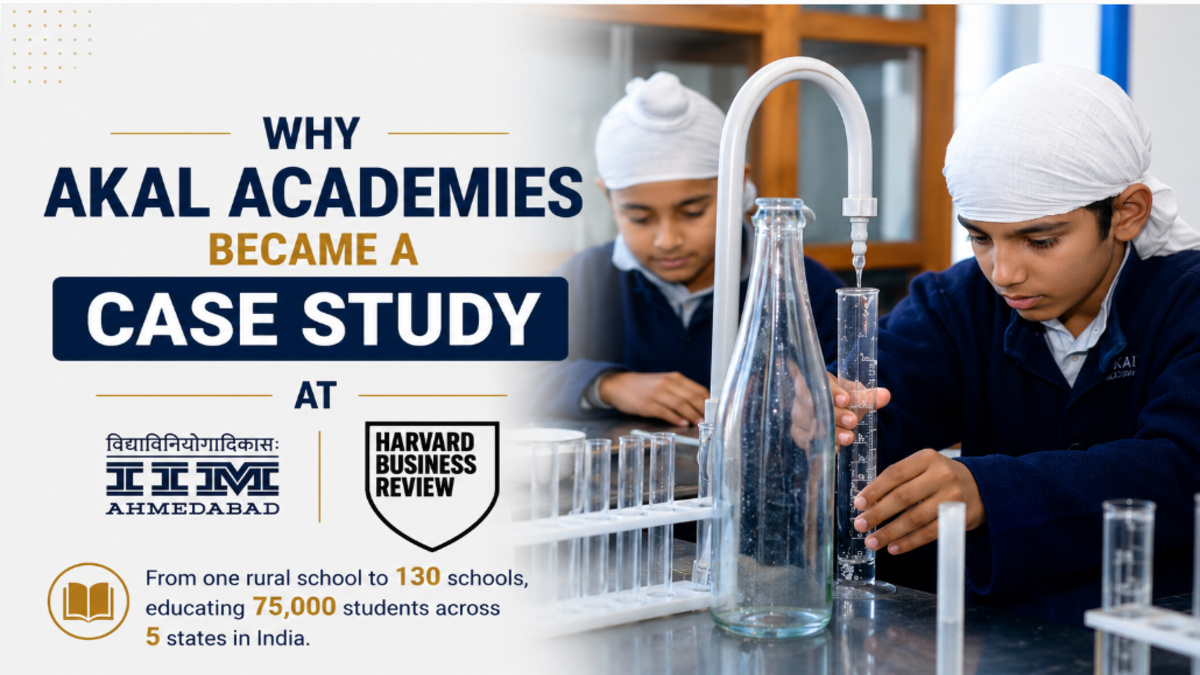
Since 1986, the organisation has worked alongside farming communities through its network of 130 Akal Academies, including 96 schools across Punjab, educating nearly 75,000 students across five northern states.
Across these four decades, one pattern has remained remarkably consistent.
When agriculture struggles, the effects do not stop in the fields.
They enter homes.
They shape educational decisions.
They determine whether many children continue learning.
Teachers and school leaders have witnessed this reality year after year.
Children do not lose their ability to learn because their families experience financial pressure.
Too often, they lose the opportunity.
The Numbers Behind the Story
The impact is visible in the Society's own educational data.
Today:
- Nearly 75,000 students study across 130 Akal Academies.
- More than 33,900 students receive free or subsidised education through scholarships and donor support.
- 1,002 students from farming families currently receive educational support through EducateToSave and related scholarship programmes..
- 49 children have lost a parent to the agrarian crisis.
These are not projections.
They are children currently studying in classrooms across rural Punjab and neighbouring states.
Their educational journeys provide an important insight into how financial support can preserve continuity during periods of family hardship.
One Student's Story Explains the Larger Picture
Statistics help explain trends.
Individual stories help us understand what those trends mean.
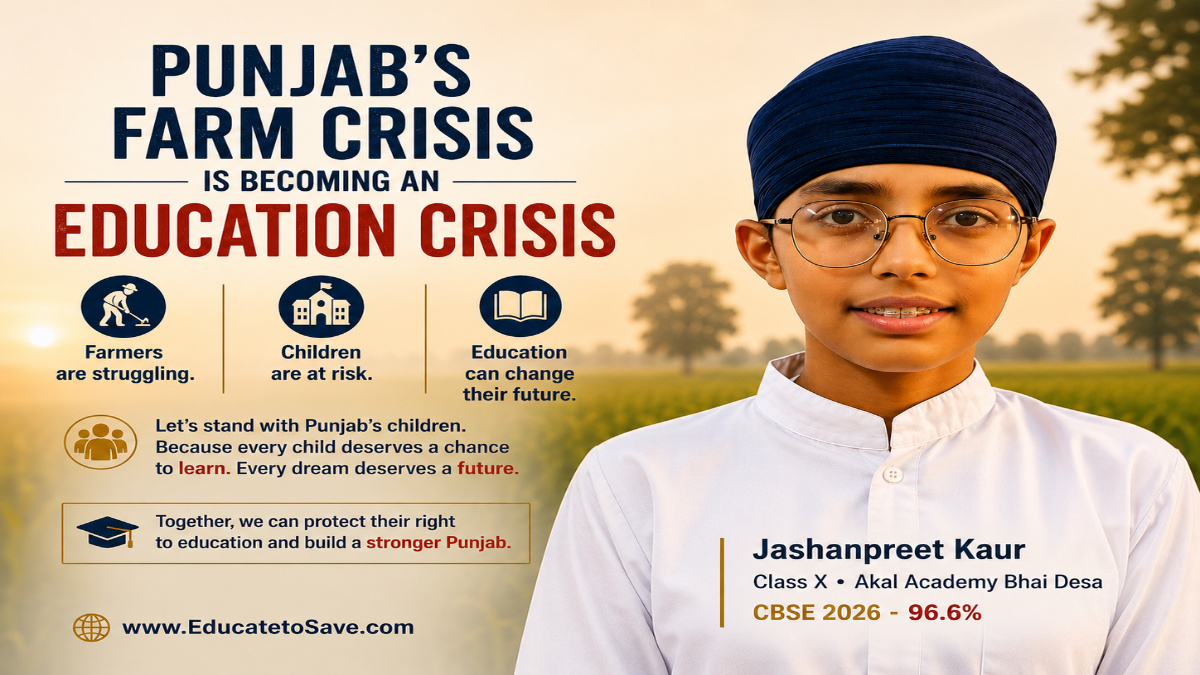
One such story belongs to Jashanpreet Kaur.
In the 2026 CBSE Class X Board Examination, she scored 96.6 percent.
It is an exceptional academic achievement.
But the examination result tells only part of her story.
Jashanpreet lost her father, Angraj Singh, to the agrarian crisis that continues to affect farming families across Punjab.
For many children facing such a loss, education becomes uncertain almost overnight.
Economic uncertainty often forces families to reconsider whether schooling can continue.
Jashanpreet remained in school.
She completed Class X.
She scored 96.6 percent.
Behind that result lies something equally important.
Educational continuity.
She continued studying because financial barriers did not become educational barriers.
Jashanpreet is supported through EducateToSave, The Kalgidhar Society's child sponsorship initiative, which helps children from financially vulnerable families continue their education despite circumstances beyond their control.
Her story demonstrates an important truth.
Academic ability rarely disappears because of poverty.
Opportunity often does.
Jashanpreet Is Not an Exception
Her achievement reflects a much larger pattern.
During the 2026 CBSE Board Examinations, 75 students from farming families appeared for Classes X and XII across Akal Academies.
Their results demonstrate what becomes possible when students remain connected to quality education despite financial adversity.
Among the Class X achievers were:
- Arpandeep Kaur – 97%
- Jashanpreet Kaur – 96.6%
- Sukhmandeep Kaur – 93.8%
- Gurnoor Kaur – 92%
- Darshpreet Singh – 91.8%
- Ramanpreet Kaur – 91%
- Harsimrat Kaur – 90%
- Gurjot Kaur – 90%
Every one of the 29 Class X students from farming families scored above 80 percent, while 14 students across Classes X and XII secured more than 90 percent.
At the Class XII level, students continued the trend.
- Gurnoor Kaur – 95.2%
- Jasmeet Kaur – 92%
- Ramanpreet Kaur – 91.4%
- Mandeep Kaur – 90.8%
- Parmeet Kaur – 90.2%
- Veerman Singh – 90%
These results are not evidence that schools can solve Punjab's agricultural challenges.
They cannot.
They do demonstrate something equally important.
Income shocks does not diminish talent.
It limits opportunity.
Preventing One Crisis from Creating Another
Agrarian distress requires comprehensive solutions.
Agricultural reforms.
Climate resilience.
Better market access.
Sustainable farming practices.
Rural economic development.
Education cannot replace these measures.
What it can do is prevent one crisis from creating another.
Evidence from around the world consistently shows that household financial shocks increase the likelihood of interrupted education, lower learning outcomes, and reduced long-term earning potential.
Keeping children in school is one of the most effective ways to protect rural communities from those long-term consequences.
Why EducateToSave Exists
EducateToSave was created around a simple idea.
No child should lose access to education because a family experiences financial hardship.
Rather than waiting until students leave school, the initiative supports educational continuity before financial pressures force difficult decisions.
Sponsors help children continue learning in the same classrooms, with the same teachers, alongside the same classmates.
That continuity changes lives.
For approximately less than a coffee a day, individuals, NRIs, philanthropists and organisations help deserving children remain in school and continue building their futures.
The support is not simply financial.
It protects opportunity.
Punjab's Future Depends on More Than Agriculture
Punjab's farmers have nourished India for generations.
The next generation deserves the opportunity to build the state's future with the same determination.
Some will become engineers.
Some will become teachers.
Some will become doctors.
Others will return to agriculture with new knowledge, technology and ideas.
None of that becomes possible if financial hardship interrupts education too early.
Success should therefore be measured by more than examination scores.
Can a child remain in school after losing a parent?
Can financial hardship be prevented from becoming educational hardship?
Can communities create systems that protect learning even during periods of crisis?
These may be some of the most important questions facing rural India today.
Related Reading
This article builds on a wider discussion about how Punjab's changing rural economy is influencing children's education.
-
Beyond Agriculture: Punjab's Farm Crisis Is Taking a Toll on Children's Education
-
How Punjab's Farm Crisis Is Shaping the Future of an Entire Generation
-
Punjab's Farm Crisis Doesn't End in the Field. It Follows Children Into the Classroom
Together, these independent editorials highlight an issue that deserves greater national attention: protecting children's education during periods of rural economic uncertainty.
Frequently Asked Questions
Why are children from farming families at greater risk of leaving school?
Financial uncertainty caused by declining farm incomes, debt, crop failures and rising cultivation costs can make it difficult for families to sustain educational expenses over many years.
How many children from farming families does EducateToSave currently support?
Across the Akal Academy network, 1,002 students from farming families currently receive educational support, including 49 children who have lost a parent due to the agrarian crisis.
How many students receive free or subsidised education?
More than 33,900 students receive free or subsidised education through scholarships and donor support across Akal Academies.
What is EducateToSave?
EducateToSave is the child sponsorship initiative of The Kalgidhar Society that helps deserving rural children continue their education despite financial hardship.
How much does it cost to sponsor a child?
A child can be supported for approximately less than a coffee a day through EducateToSave.com.
How many schools does The Kalgidhar Society operate?
The Society operates 130 Akal Academies, including 96 schools across Punjab, serving nearly 75,000 students.
A Farming Crisis May Begin in the Field. It Should Never Decide a Child's Future.
Punjab's agricultural challenges deserve serious economic solutions.
They also deserve educational ones.
Every child who completes school despite adversity strengthens a family, a village and the future workforce of the country.
Jashanpreet Kaur's 96.6 percent is more than an examination result.
It is evidence that resilience, when matched with opportunity, can overcome circumstances that might otherwise have ended a child's education.
That is the purpose of EducateToSave.
Not simply to sponsor children.
But to protect continuity, preserve opportunity and ensure that a family's temporary financial hardship never becomes a child's permanent educational loss.
Editor's Note: Student data referenced in this article is based on institutional records maintained by The Kalgidhar Society for the 2025-26 academic year.