From One Rural School to 130: Why Akal Academies Became a Case Study at IIM Ahmedabad and Harvard Business Review
Some institutions are measured by the campuses they build. Others are remembered for the ideas they leave behind.
Every year, business schools across the world analyse organisations that have changed industries, solved complex management challenges or redefined the way institutions grow. Most case studies feature multinational corporations, technology giants or successful startups.
It is uncommon for a rural school network from India to enter that conversation.
Yet Akal Academies did.
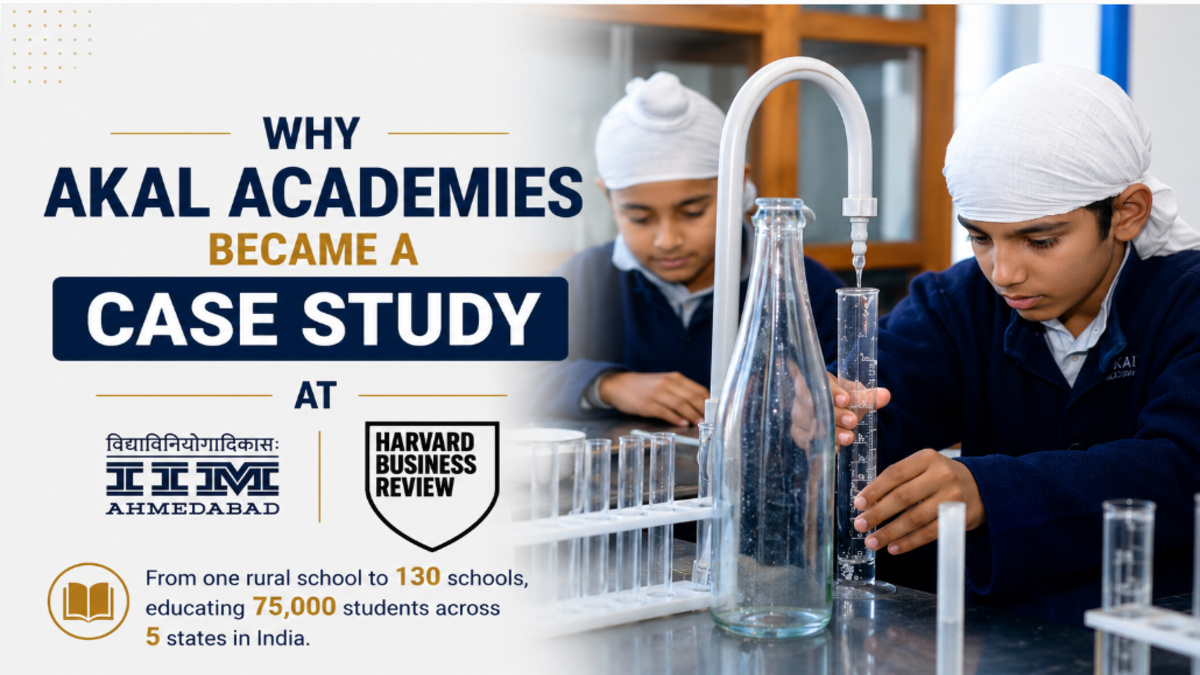
What began as a single school in rural Punjab has, over nearly four decades, grown into a network of 130 CBSE English-medium schools, educating nearly 75,000 students across Punjab, Himachal Pradesh, Haryana, Rajasthan and Uttar Pradesh. Along the way, the journey attracted the attention of researchers at IIM Ahmedabad, one of India's premier management institutions. Their case study was later selected for the Harvard Business Review (HBR) Case Collection, making the Akal Academies model available to management students and business leaders worldwide.
The recognition wasn't about the number of schools.
It was about a question every growing organisation eventually faces:
How do you scale without losing your purpose?
More Than Expansion
Growth is easy to measure.
Impact is not.
Many organisations expand quickly, only to discover that the very qualities that made them successful become harder to preserve as they grow. Maintaining quality, culture, financial sustainability and community trust becomes increasingly complex.
That challenge lies at the heart of the Akal Academies story.
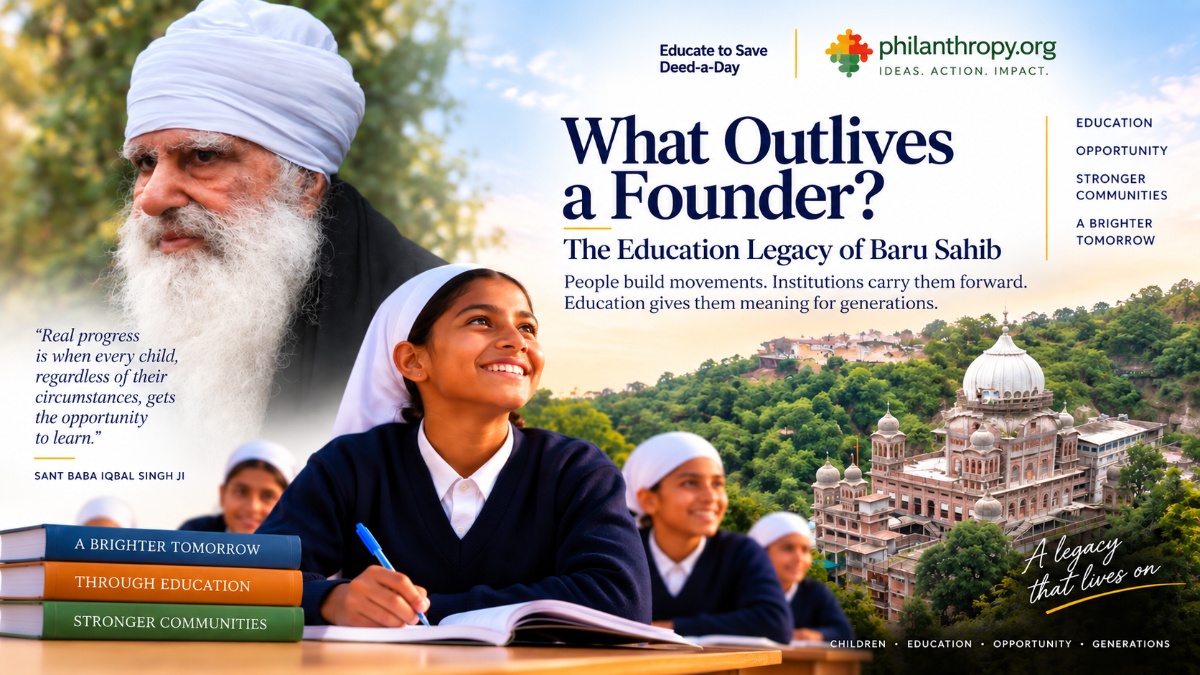
When Padma Shri Sant Baba Iqbal Singh Ji envisioned the first Akal Academy, his objective was never to build the largest school network. His focus was far simpler and far more demanding—to bring quality, English-medium, value-based education to children living in villages who had little access to the opportunities available in cities.
The first school was established with that belief.
Everything that followed was built on it.
A Model Worth Studying
Academic case studies are rarely written as awards.
They exist because an organisation presents a challenge worth understanding.
The study titled "The Akal Academies: Schooling the Rural Children in India," authored by Dr. A. S. Ghura and Prof. Vijay Sherry Chand of IIM Ahmedabad, examines precisely that challenge.
Rather than asking whether Akal Academies succeeded, it asks how they succeeded.
How does a mission-driven institution grow from one rural school to 130 schools?
How does it preserve educational quality across multiple states?
How does it remain financially sustainable while serving communities where affordability remains a constant concern?
How does it expand without losing the trust of parents, teachers and local communities?
These are not questions unique to education.
They are questions faced by every organisation trying to create lasting impact.
The significance of the study grew further when it was selected for the Harvard Business Review Case Collection, allowing students, researchers and executives around the world to study the Akal Academies model alongside case studies of globally recognised organisations.
Read the original case studies:
- Harvard Business Review Case Collection: https://store.hbr.org/product/the-akal-academies/A00097
- IIM Ahmedabad Case Study (PDF): https://files.elfsightcdn.com/eafe4a4d-3436-495d-b748-5bdce62d911d/37f8c380-4bb1-4bfe-8e93-0b2eecaf1bbe/Case_Study.pdf
Forty Years, One Philosophy
Across four decades, the geography changed.
The mission did not.
Today, Akal Academies serve children from farming families, daily wage earners, small business owners, granthis, and countless households where quality education once seemed beyond reach.
Each new campus brought fresh challenges—finding committed teachers, building relationships with communities, creating sustainable infrastructure and maintaining consistent academic standards.
Growth was never pursued for its own sake.
It followed trust.
Village by village.
School by school.
Student by student.
That steady approach explains why the story continues to resonate beyond education circles. It offers a lesson in institution building—one where patience mattered more than speed and purpose mattered more than scale.
Every Number Represents a Child
Statistics often dominate conversations about education.
130 schools.
75,000 students.
Five states.
Yet behind every number is a child whose future depends on whether education remains within reach.
For many families studying in Akal Academies, financial circumstances continue to be a challenge. Through EducateToSave.com, individuals across India and around the world sponsor the education of children from underserved families, ensuring that talent is not limited by economic hardship.
A sponsorship is often described as support for one student.
In reality, it does something larger.
It connects that child to an educational ecosystem refined over nearly forty years—an ecosystem that researchers considered worthy of academic study because it demonstrated that rural education can be both scalable and sustainable.
When a donor chooses to support a child, they are investing in more than a classroom.
They are investing in a model that has consistently worked across generations.
The Story Isn't Finished
Case studies rarely celebrate the past.
They ask what comes next.
For Akal Academies, the next chapter will not be written in a business school classroom or a research paper.
It will be written in villages where another child stays in school instead of dropping out.
It will be written by teachers who choose to serve rural communities.
It will be written by families who believe education can change the course of a generation.
And it will be written by every individual who decides that a child's future is worth investing in.
The journey from one school to 130 schools did not happen overnight.
It happened because thousands of people believed that where a child is born should never decide how far that child can go.
That idea was powerful enough to become a case study.
Its greatest success, however, is that it continues to become a lived reality for thousands of children every single day.
About EducateToSave
EducateToSave is an initiative of The Kalgidhar Society that connects compassionate individuals with children from underserved rural families seeking access to quality education. The initiative supports students studying in the Society's network of 130 Akal Academies, helping ensure that financial hardship never becomes a barrier to learning.
IndiaCSR.in covered this story at https://indiacsr.in/akal-academies-harvard-iim-ahmedabad-case-study/